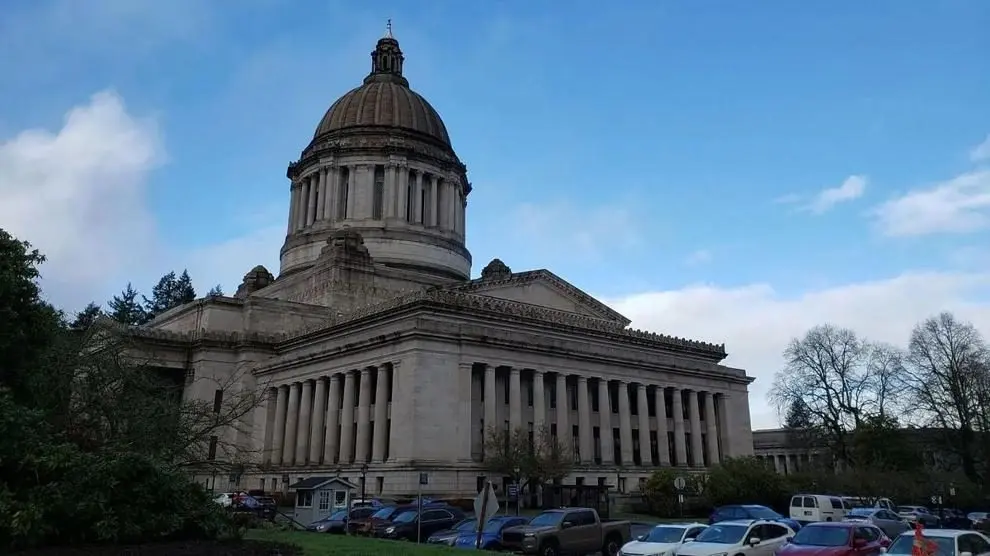
WASHINGTON STATE – Washington lawmakers are warming up for a sprint. They’ve been pre-filing bills and holding press conferences this week, knowing they’ll have just 60 days to drive their policy ideas through the legislative process once next year’s session starts Jan. 12.
Being proactive, they hope, will get them on the radar of committee and caucus leaders who hold great sway on what legislation will be considered. Competition will be tough. Hundreds of bills introduced but not enacted in the last session are already well-positioned for early votes in the House or Senate.
Here’s a look at a few new bills now in the hopper.
Tax the protest
Not a single Republican legislator voted this year for a new law imposing the retail sales tax on more services, such as temporary staffing, certain digital advertising, and security services.
Now that this tax law is in effect, a Republican state senator wasted little time in pursuing a change to make sure it covers the profession of protesting.
With Senate Bill 5819, Sen. Leonard Christian, R-Spokane Valley, proposes to expand the definition of temporary staffing services to include “providing workers as paid protestors to any person, business, or other entity for limited periods of time to supplement or support a public protest.”
Coverage of protests at the U.S. Immigration and Customs Enforcement facility in Portland sparked Christian’s interest. “You see some people over and over on the protest lines,” he said.
If it’s happening here, or if a group is paying Washington residents to protest in Oregon, it probably should be subject to the tax, he said.
“This idea came from the other side of the aisle, saying there’s no such thing as a paid protester,” Christian said. “If the state thinks it can get some money, well, any money is better than nothing with the budget situation.”
Embracing nuclear power
Washington has doggedly pursued ways to slash greenhouse gas emissions and curb the state’s appetite for fossil fuels.
It means securing greater supplies of clean energy to power homes, cars and businesses. Solar, wind and hydropower are cornerstones of the state’s strategy. Some heavyweight lawmakers from opposite sides of the aisle think nuclear energy should be one as well.
Identical bills pre-filed in the House and the Senate push the state to more aggressively embrace nuclear energy. They direct the state Department of Commerce to publish a “nuclear power strategic framework” identifying opportunities and obstacles to encouraging, enticing and permitting development of new fission nuclear power generation facilities.
Rep. Stephanie Barnard, R-Pasco, and House Majority Leader Joe Fitzgibbon, D-West Seattle, teamed up in the House while Senate Minority Leader John Braun, R-Centralia and Sen. Sharon Shewmake, D-Bellingham, are the lead sponsors in the Senate.
There is a catch. Commerce will not get any state dollars. It must secure enough private funds to do the work, or it won’t get done.
Other tax matters
This week brought proposals to impose a new tax on businesses, restore a tax break on bullion and hike a fee used to help new car buyers.
Rep. Jeremie Dufault, R-Selah, wants to reinstate a tax exemption on the sale of precious metals and bullion. It is one of a handful of tax breaks Democrats eliminated last session with Senate Bill 5794. If the tax break comes back, the state would lose out on $129 million over the course of this budget and the next one.
Rep. Shaun Scott, D-Seattle, is forging ahead with his proposed new tax targeting large employers with high-paid workers. Under his bill, companies with more than 20 employees and $5 million in gross receipts would pay a tax on payroll expenses for those workers earning more than $125,000 a year. He held a press conference Tuesday to tout it.
Two Democratic senators filed the first fee increase proposed for the next session. It comes at the request of the Attorney General Nick Brown. The bill from Sens. Marcus Riccelli of Spokane and Derek Stanford of Bothell would increase the fee auto buyers pay for the new motor vehicle arbitration account to $6. It is now $3.
It would be the first update in over three decades to the fee, according to the attorney general’s office. Money is used to help new vehicle owners who have problems with warranty repairs. The account is projected to run into a deficit this fiscal year and an increase would ensure it remains financially solvent.
Tuition break
Washington’s higher education institutions are reeling from lawmakers’ handiwork last session that led to budget cuts, tuition hikes and a crimping of the state’s generous financial aid programs.
Enter Rep. Julia Reed, D-Seattle, with an attempt to reset the scales.
Her legislation titled “Adjusting higher education funding” would cut tuition by 10% a year for three school years starting in the fall of 2027 and expand eligibility for the Washington College Grant program.
To pay for the changes, she proposes to erase the cap on annual payments of the state’s “advanced computing surcharge.” This may be a sticking point.
This tax is paid by firms with global revenue above $25 billion — think Microsoft and Amazon — and is spent to expand student access to higher education through efforts like the Washington College Grant. Under a law passed last session, the annual cap on payments, now $9 million, will rise to $75 million per taxpayer on Jan. 1.
The notion of erasing it completely came up last session. It may be too soon to revisit.
Political hate crimes
Sen. Phil Fortunato, R-Auburn, is once again proposing to make it a hate crime to assault or threaten a person, or damage their property because of their “political affiliation.”
This isn’t his first attempt. Earlier this year, when the state Senate debated and approved an expansion of the state’s hate crime law, Fortunato offered an amendment to add political affiliation to the law’s roster of characteristics, such as race, religion, gender, and sexual orientation
At the time, Fortunato cited an incident at Washington State University in which a student, described as a Republican and member of Turning Point USA, was reportedly attacked by two university employees while wearing a “Trump 2024: Take America Back” hat.
“If we’re going to protect people from violence based on who they are or what they believe, then that must include political views,” Fortunato said at the time. “Otherwise, the law is just a political tool for the majority party.”
In Washington, hate crime offenses are a class C felony that carries a potential penalty of up to 5 years behind bars, a fine of up to $10,000, or both.
Washington State Standard is part of States Newsroom, a nonprofit news network supported by grants and a coalition of donors as a 501c(3) public charity. Washington State Standard maintains editorial independence. Contact Editor Bill Lucia for questions: info@washingtonstatestandard.com.