WASHINGTON, D.C. – Future assessments of U.S. landslide hazards could include the study of risks posed by atmospheric rivers, which caused extreme precipitation that was linked to recent deadly slides in Southeast Alaska.
The added focus on atmospheric rivers is one of the main updates in a bill that would reauthorize the National Landslide Preparedness Act. The bill, sponsored by U.S. Sen. Lisa Murkowski, R-Alaska, passed the U.S. Senate on Monday and is now to be considered by the U.S. House.
The initial National Landslide Preparedness Act was signed into law five years ago. That bill broadened the National Landslide Hazards Program led by the U.S. Geological Survey and established a multiagency system to coordinate landslide preparedness and response.
Atmospheric rivers are long and transitory bands of moisture and heat, likened to rivers in the sky. They carry that moisture northward from more southern latitudes, and they can dump vast amounts of rain for several hours or even days.
“You can very rapidly saturate soils in the right conditions,” said Rick Thoman, a scientist with the Alaska Center for Climate Assessment and Preparedness at the University of Alaska Fairbanks.
When such large amounts of warm southern moisture hit the steep mountainous regions of Southeast Alaska, they can cause sudden downhill flows, Thoman said.
“It’s really that intense amount of rain that atmospheric rivers deliver that’s the link to landslides,” he said.
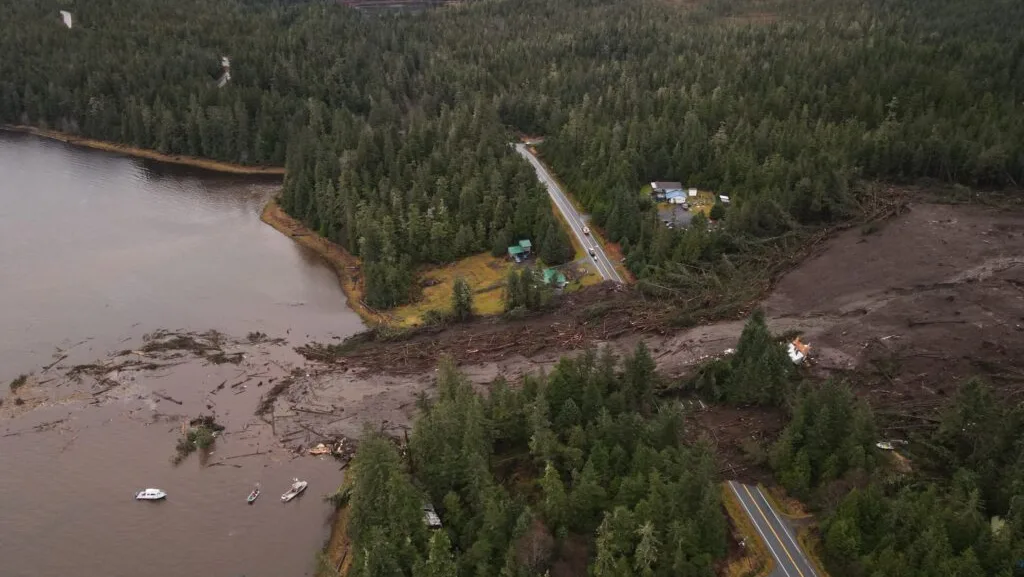
Numerous landslides in the United States have been triggered by atmospheric rivers’ extreme precipitation. Those events include the 2023 slide in Wrangell that killed six people, the 2020 slide in Haines that killed two people and the 2015 slide in Sitka that killed three people.
The National Landslide Preparedness Act Reauthorization Act passed the Senate by unanimous consent. It is co-sponsored by U.S. Sen. Maria Cantwell, D-Washington, whose state was the site of the 2014 Oso landslide that killed 43 people.
Extreme precipitation events from atmospheric rivers are tied to shallow-seated landslides such as the deadly events that struck Southeast Alaska in recent years. Other types of Alaska landslides are caused by more deep-seated slope failures triggered by glacial retreat, permafrost thaw or a combination of those forces.
Also passed on Monday by unanimous consent in the Senate was another Murkowski-sponsored and disaster-focused bill, the National Earthquake Hazards Reduction Program Reauthorization Act. That bill, co-sponsored by U.S. Sen. Alex Padilla, D-California, supports the federal program that maintains earthquake measurement resources and equipment and equipment and early warning systems.
“Earthquakes and landslides are active threats that have taken lives and damaged property across Alaska in recent years,” Murkowski said in a statement issued Tuesday. “Our passage of these bills puts us on track to ensure that federal agencies have the resources they need to help keep communities safe both back home and around the country. I thank my colleagues for working cooperatively to pass these measures and urge the House to take them up and send them to the President as soon as possible.”
This story was originally produced by Alaska Beacon, which is part of States Newsroom, a nonprofit news network which includes Washington State Standard, and is supported by grants and a coalition of donors as a 501c(3) public charity.
Washington State Standard is part of States Newsroom, a nonprofit news network supported by grants and a coalition of donors as a 501c(3) public charity. Washington State Standard maintains editorial independence. Contact Editor Bill Lucia for questions: info@washingtonstatestandard.com.