PULLMAN, WA – Landscape architecture students at Washington State University are part of a project that could change the prison experience in Washington.
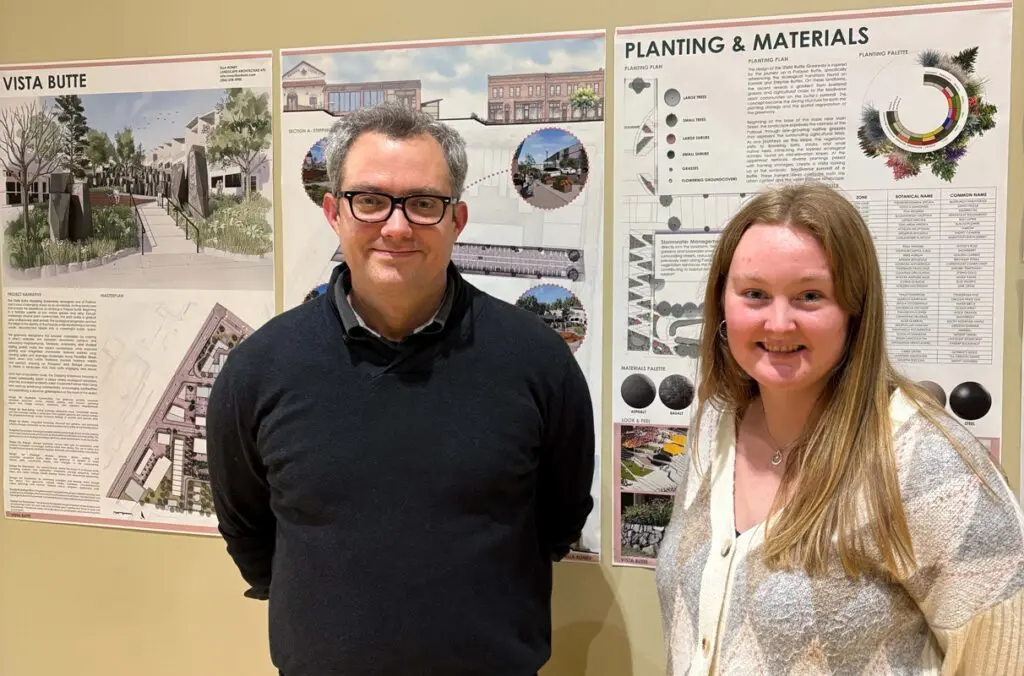
Assistant Professor Dan Cronan’s assignment to students in his undergraduate studio class: redesign the exercise yard at the Washington State Penitentiary’s minimum-security unit in Walla Walla. Their designs would transform a bare-bones field into a multi-use space with greenery, walking paths, athletic fields, and seating areas.
The potential redesigns are just one aspect of the Washington Way, a state Department of Corrections initiative to introduce greater normalcy to portions of the prison environment.
Normalization means that some aspects of prison life should resemble life outside of prison as much as possible, particularly for those who are nearing the end of their confinement and have demonstrated progress toward rehabilitation.
WSU students redesigned the exercise yard, transforming a bare-bones field into a multi-use space with greenery, walking paths, athletic fields, and seating areas.
Creating that culture and environment has been shown to improve working conditions for corrections officers, who experience work-related stress and suicide at rates much higher than average. It also increases the likelihood that prisoners make a successful return to outside life, said Bradley Bowman, associate superintendent of the Washington State Penitentiary.
The Department of Corrections got in touch with WSU to ask about taking on the landscape architecture project. The undergraduate studio class and program has long tackled service-learning projects for communities, though this was the first time working with a prison, Cronan said.
That meant more advanced work than the typical student project. Students needed security clearances to enable them to visit the penitentiary and talk to inmates and corrections officers. Their surveys soliciting feedback had to be on paper. And there were unique guidelines to follow, such as no dense plantings that could be used to hide contraband, no tall trees, and maintaining clear lines of sight through the yard.
Landscape architecture student Ella Roney’s design was ultimately chosen by corrections officials. It features paved gathering places, a multiuse sports field and sports courts, a running or walking path, seating areas, and planters that can be moved to adapt to needs. Murals that could be painted by inmates cover the tall concrete walls surrounding the yard. Inmate labor would be used as much as possible to build stewardship for the space.
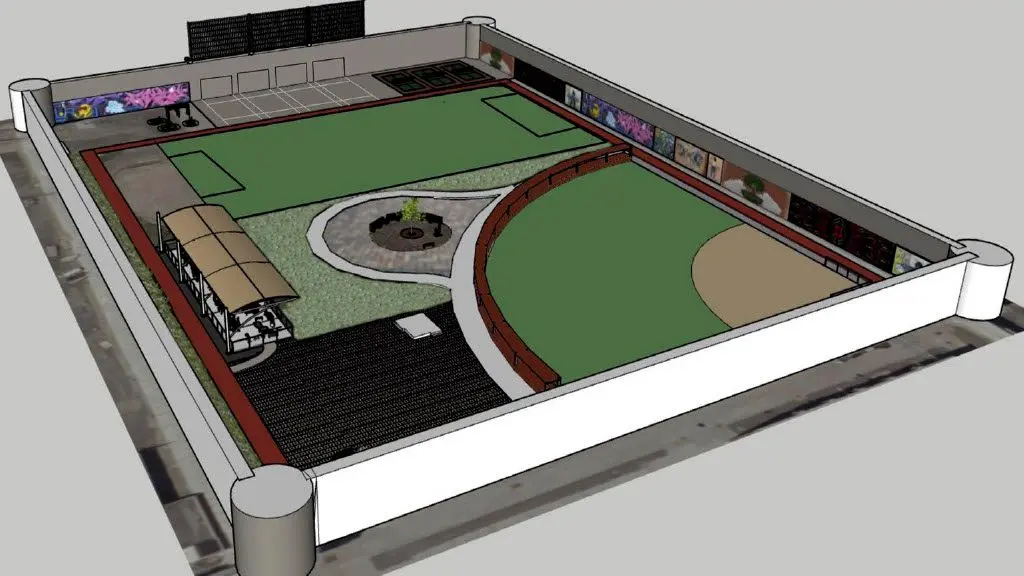
Bowman said corrections officials were “blown away” by the WSU students’ work. “They did an amazing job,” he said. “We met with them three or four times, they would ask us questions and provided us with multiple options throughout.”
Corrections officials visited Norway in the fall, a country whose humanistic approach to incarceration has led to the least amount of violence and lowest rates of recidivism in the world. They took Roney’s design with them and talked about the Washington Way initiative with experts there. Bowman said he knows state funding could be challenging in the current budget environment but “we’re not giving up on this huge goal of ours.”
Cronan said the project opened students’ eyes as well as his own. Through his preparation for the studio experience, he connected with others in higher ed who specialize in landscape architecture for prison environments. They’re now collaborating on a paper to be presented to the Council of Educators in Landscape Architecture in March.
While students were initially lukewarm, after visiting the penitentiary and talking with inmates and corrections officials there, he said their attitude changed to, “Hey, we have to do this. They need this. We’re doing a good thing here.”