WASHINGTON, D.C – In the past two years, a dozen states have either approved new U.S. House maps or are moving toward doing so — a highly unusual mid-decade revamp prompted by President Donald Trump and a U.S. Supreme Court ruling late last month. And the situation isn’t settled yet — even as ballots are being printed and early voting is already underway in some places. Pending litigation could scramble the situation even further.
Redistricting, the process of redrawing the geographic boundaries of U.S. House and state legislative districts, usually takes place every 10 years following the census.
Trump upended that schedule early last year, when he began pressuring state GOP officials to redraw their maps to help Republicans hold onto a slim, five-seat majority in the U.S. House ahead of potentially grim 2026 midterm elections for his party.
The Supreme Court recast the redistricting fight with its ruling in Louisiana v. Callais. That decision all but nullified a provision of the federal Voting Rights Act that required states to draw electoral maps to give racial minority voters the opportunity to elect their chosen candidates.
A total of nine states — Alabama, California, Florida, Missouri, North Carolina, Ohio, Tennessee, Texas and Utah — have redrawn their maps since last year. At least three other states — Georgia, Louisiana and South Carolina — appear likely to follow suit, though Georgia’s new maps would not be in effect for the upcoming midterm elections.
As things currently stand, Republicans are likely to gain up to 17 seats, while Democrats are likely to gain up to six seats.
In the aftermath of the Callais decision, hundreds of protesters have gathered at statehouses in recent weeks, particularly in the South, to decry what they say is a concerted effort to dilute Black voting and governing power. Republicans argue that maps should be “colorblind.” Gerrymandering to benefit one political party over another is legal at the federal level, though some states have their own laws restricting it.
The latest redistricting efforts are changing elections that have already begun. Some candidates must now pivot to races in brand-new districts with just a few weeks until their primaries. They’ve spent money and time reaching people who can no longer vote for them, fighting opponents different from the ones they now face. At least one Tennessee Democratic candidate no longer lives within the new boundaries of the district he’s seeking to represent.
Voters in states such as Alabama will now be asked to turn out for primary elections in both May and August, in addition to the November general election.
Here’s where things stand now.
Nine states already have redrawn their maps
Alabama
Republicans could gain 1 seat.*
A 2023 court order required Alabama to draw a congressional map with a second majority-Black district. But after the Callais decision last month, Alabama’s Republican state officials asked the U.S. Supreme Court to let them reinstate the old map, which has just one majority-Black, majority-Democratic district and which the court had previously ruled racially discriminatory. The high court quickly agreed.
Republican Gov. Kay Ivey has announced new primary elections in August for the affected districts. These will be held in addition to next Tuesday’s statewide primaries for other federal and state offices.
Alabama is also appealing a separate ruling requiring it to redraw two state Senate districts. That case is still ongoing.
California
Democrats likely to gain 3-5 seats.
California Gov. Gavin Newsom last year led the Democratic response to Trump’s call for Republican-led states to redraw their congressional maps.
In November 2025, California voters approved Newsom’s proposal to temporarily override the state’s independent redistricting commission and instead to allow the Democratic-dominated legislature to redraw the maps to create districts more favorable to Democrats. The new map is valid through 2030.
Florida
Republicans likely to gain 1-4 seats.
Last month, the Republican-majority Florida Legislature approved Republican Gov. Ron DeSantis’ new congressional map that could net the GOP up to four new congressional seats.
Both DeSantis and the voting rights organizations suing to block the new map agree it violates parts of the state constitution. But DeSantis argues the constitution’s anti-gerrymandering amendments, which were overwhelmingly adopted by Florida voters in 2010, are invalid, partly due to the Callais ruling.
Missouri
Republicans likely to gain 1 seat.
Earlier this week, the Missouri Supreme Court upheld the state’s gerrymandered 2025 congressional map, handing Republicans a victory. Last summer, Trump pressured Missouri Republicans to help maintain the GOP majority in the U.S. House, so lawmakers met in a special session to draw a map that likely will give them an additional seat by carving off parts of Kansas City into surrounding rural districts.
The new map will be used in Missouri’s August primary, the state Supreme Court ruled this week, because it’s uncertain whether a referendum petition seeking to repeal the map will succeed.
North Carolina
Republicans likely to gain 1 seat.
At Trump’s behest, North Carolina’s Republican-controlled legislature redrew the state’s congressional map last fall. It was an effort to make the state’s only competitive district solidly Republican. The maps passed strictly along party lines. The state’s congressional delegation is now likely to be 11 Republicans and three Democrats. North Carolina Gov. Josh Stein is a Democrat, but redistricting isn’t subject to the governor’s veto.
Ohio
Republicans likely to gain up to 2 seats.
Last fall, Ohio Republican House Speaker Matt Huffman publicly rebuffed Trump’s national push to gain more seats in Congress, while state Democrats proposed their own maps. An Ohio redistricting commission eventually approved a new map last October that is likely to yield 12 Republicans and three Democrats, compared with the current 10-5 split. GOP and Democratic lawmakers called it a “compromise.”
That map will be in place for the next six years. But political operatives told the Ohio Capital Journal they expect to see more redistricting efforts in 2030.
Tennessee
Republicans likely to gain 1 seat.
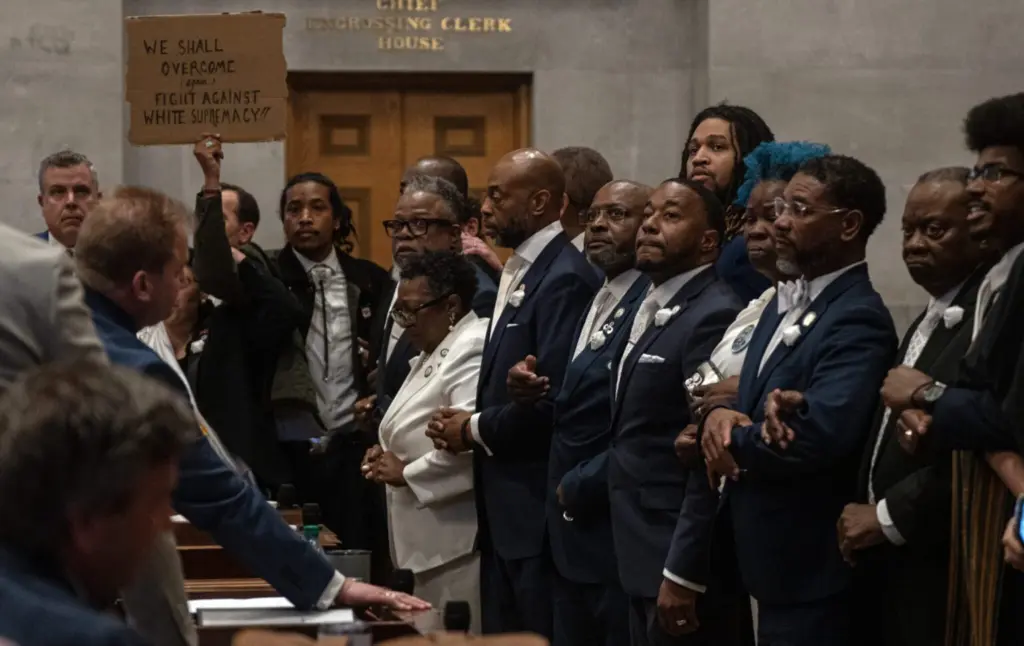
In a chaotic special session earlier this month, Republican lawmakers in Tennessee redrew congressional maps to shatter the state’s only majority-Black, majority-Democratic district. The newly passed map now favors Republicans in all nine Tennessee districts. Hundreds protested at the Tennessee statehouse as House Republicans voted on the new map and House Democrats gathered at the front of the chamber, locking arms in a show of solidarity.
This week, Tennessee House Speaker Cameron Sexton, a Republican, punished his Democratic colleagues for their protests by stripping them of committee and subcommittee appointments.
Texas
Republicans likely to gain 3-5 seats.
The nation’s redistricting battle kicked off in Texas last summer, after Trump pressured the Texas GOP to redraw the state’s congressional map to add up to five more Republican seats. State House Democrats pushed back, fleeing the state temporarily in August to halt the vote. But the map eventually passed after they returned. Civil rights groups sued, saying the new map was racially discriminatory.
In April, the U.S. Supreme Court permanently upheld the new map, ensuring it remains in place for the 2026 midterms.
Utah
Democrats likely to gain 1 seat.
In 2018, Utah voters approved an anti-gerrymandering ballot measure that created an independent redistricting process, but Utah’s Republican-dominated legislature repealed and replaced it in 2021. Voters rights groups sued, arguing the resulting new map was a partisan gerrymander.
Eventually, after a multi-year legal battle, a new court-ordered map in 2025 gives Democrats a chance to win one of the state’s four congressional districts. The Utah GOP proposed a ballot initiative this year to ask Utah voters to officially repeal the 2018 anti-gerrymandering law, but it failed last month after thousands of petition signers removed their signatures.
Three states are in the process of redrawing their maps
Georgia
Georgia Republican Gov. Brian Kemp has refused to pursue redistricting ahead of this year’s elections, which are already underway. But Kemp announced Wednesday that he will call a special session to redraw the state’s political maps for the 2028 elections. Georgia’s congressional delegation currently has nine Republicans and five Democrats.
Louisiana
Republicans could gain 1 seat.
The day after the U.S. Supreme Court struck down Louisiana’s existing congressional districts as an unconstitutional racial gerrymander, Republican Gov. Jeff Landry suspended the state’s congressional primaries to give lawmakers enough time to pass new maps.
This week, in a nearly 10-hour overnight committee hearing, Louisiana lawmakers advanced a bill that would eliminate one of the state’s two majority-Black districts. The new map, if it passes, likely would give Republicans another seat in Congress.
The new map must win approval from both chambers by June 1. Litigation over the decision to delay primaries is ongoing.
South Carolina
Republicans could gain 1 seat.
South Carolina legislators will gather Friday for a special session to redraw the state’s congressional lines just 12 days before early voting opens. Lawmakers have set a deadline of May 26 to pass a new map. Republican Gov. Henry McMaster, who previously said the matter was for the legislature to decide, called for the special session under pressure from the White House and state GOP.
The South Carolina GOP’s goal is to pass a bill that would delay U.S. House race primaries until August while keeping other primaries on schedule for June. One proposed map would cut South Carolina’s lone congressional Democrat, U.S. Rep. Jim Clyburn, out of the seat he’s represented since 1992 and create all seven Republican seats.
At least a half dozen other states are interested in redrawing their maps
Mississippi
This week, Mississippi Republican Gov. Tate Reeves canceled a special legislative session he’d called to redraw districts for the state’s Supreme Court. Some GOP officials had hoped he’d add congressional redistricting to the agenda. Instead, he said this week, he’s working with Trump and the White House on a plan to redraw Mississippi’s congressional districts and legislative districts in the future. Reeves wants a map that would boot the lone Democrat in Mississippi’s U.S. House delegation, Rep. Bennie Thompson, from his seat.
If that happens, Republicans would likely gain one congressional seat.
Virginia
The Virginia Supreme Court earlier this month struck down a voter-approved redistricting amendment that could have given Democrats a 10-1 advantage in the state’s U.S. House delegation. Virginia voters last month had approved a referendum that would have netted Democrats three or four additional seats. Earlier this week, Virginia Democrats asked the U.S. Supreme Court to revive the amendment, in a case that’s ongoing.
Arizona, New Jersey, New York, Washington
Officials in Arizona, New Jersey, New York and Washington all have suggested drawing new maps following the Callais decision, according to the National Conference of State Legislatures.
The Colorado Voting Rights Act, passed last year by the state’s Democratic-majority legislature, will likely prevent the state from embarking on a redistricting effort. The state’s congressional delegation is currently split 4-4 between Democrats and Republicans. But a Democratic-led group is gathering signatures for ballot measures that would allow the state to change its maps ahead of the 2028 election.
*Seat gain predictions from The Cook Political Report.
Stateline reporter Anna Claire Vollers can be reached at avollers@stateline.org.
Stateline is part of States Newsroom, a nonprofit news network supported by grants and a coalition of donors as a 501c(3) public charity. Stateline maintains editorial independence. Contact Editor Scott S. Greenberger for questions: info@stateline.org.