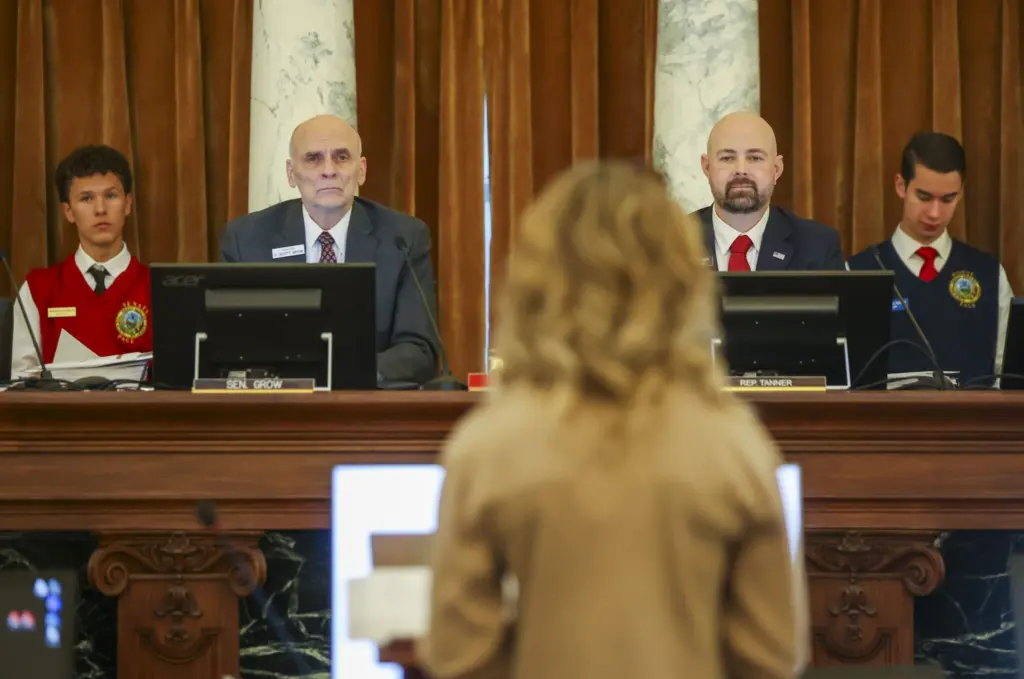
BOISE, ID – The Idaho Legislature’s budget committee approved a series of cash and interest payment transfers Wednesday that are intended to avoid a budget shortfall and leave a surplus cash balance in the state budget.
New report shows Idaho again facing projected budget deficit
In doing so, the Joint Finance-Appropriations Committee, or JFAC, employed a strategy that its co-chairman Rep. Josh Tanner, R-Eagle, has routinely described as an irresponsible short-term gimmick that does not structurally balance the budget.
The transfers are intended to avoid a budget shortfall in the current fiscal year 2026 and fiscal year 2027 and leave a projected cash surplus of $150 million at the end of fiscal year 2027, Tanner and JFAC’s other co-chairman Sen. Scott Grow, R-Eagle, said.
“(It’s to) make sure that we’ve got a balanced budget, that we make sure that we have enough revenue on the bottom line,” Tanner said in an interview Wednesday. “As you’ve seen throughout this year, especially in (fiscal year) 2026, we’ve had quite a bit of volatility within the revenue as it has come in. We want to make sure that, if for some reason, that revenue does not show up, that we’ve covered ourselves and are not leaving a hole.”
Grow described the transfers as a short-term fix.
“So a stabilized budget is what we hope for always where ongoing revenues are sufficient to cover ongoing expenses,” Grow said. “We don’t have that right now, and so this is the short-term fix to a problem that was existing with a budget that doesn’t have ongoing revenues matching ongoing expenses. We’re covering it one-time.”
The transfers total $131.9 million in fiscal year 2026 and $95.5 million in fiscal year 2027.
In addition to transferring interest earnings into the state’s general fund, JFAC also approved a $32.9 million transfer to bolster funding for the fire suppression deficiency account to pay for wildfire response and another $32.9 million for the Idaho Transportation Department’s strategic initiatives fund.
Finally, JFAC called for reducing their own funding for the legislative account by 4% in fiscal year 2026 and 5% in fiscal year 2027, in line with most other state agencies and departments. The move to reduce funding for the legislative account occurred two days after the Idaho Capital Sun reported that several experienced members of the Idaho Senate have called out the Idaho Legislature for not cutting its own funding at the same levels it cut the budgets for other state agencies and departments.
Idaho Gov. Brad Little recommended cash and interest transfers at the beginning of the year
In conjunction with his Jan. 12 State of the State address, Gov. Brad Little recommended using some of the very same funds transfers to balance the budget.
The next day, Tanner publicly criticized him and called the process an irresponsible gimmick.
Some Idaho senators call out state Legislature for not cutting its own budget alongside others
“The Governor’s budget does not balance,” Tanner wrote in a press release he issued Jan. 13. “It relies on one-time gimmicks, spends more than the state takes in on an ongoing basis, and leaves Idaho with the lowest ending fund balances in nearly a decade.”
In the press release, Tanner “emphasized that the budget abandons a core Idaho budgeting principle: ongoing expenses must be paid with ongoing revenues.”
“This is a structurally unbalanced budget,” Tanner added in his January press release. “Temporary fixes are being used to mask permanent spending commitments. That is not sustainable, and it is not responsible.”
But on Wednesday, Tanner and JFAC approved seven interest transfers that are based on recommendations Little issued first. Tanner voted in favor of each of the 14 transfers on JFAC’s agenda Wednesday.
When an Idaho Capital Sun reporter asked Tanner after Wednesday’s meeting about using similar transfers to the ones he had criticized Little for, Tanner said there is a difference between the two approaches.
“We’re just using it as a cushion, instead of using it for balancing our budget,” Tanner told the Sun.
“We’re just cautioning against that aspect, so we’re not using the one-time funds to balance out our budget,” Tanner added. “We’re using them as a cushionary aspect that they would revert back if unneeded.”
After JFAC’s meeting Wednesday, Grow highlighted five sources of uncertainty that he said justify the budget transfers:
- Ongoing state revenue uncertainty, which Grow said the state must cover for.
- Uncertainty over the cost of conforming to federal tax cuts from the One Big Beautiful Bill Act, in particular uncertainty over the true cost of corporate tax changes and research and development.
- A potential supplemental funding request coming next year for Medicaid expenses.
- A potential supplemental funding request next year for Idaho Department of Correction expenses.
- A potential supplemental funding request next year for wildfire bills.
“So we’re kind of cautious of all our things in such a way that we can feel comfortable when we leave here (and adjourn the legislative session for the year) that we’ve got things under control,” Grow told the Sun.
Budget transfers show some legislators still worry about state’s ability to balance the budget
JFAC’s approval the 14 cash and interest transfer proposals represent an unmistakable public signal that some members of JFAC are concerned that the budgets they spent the first 72 days of the 2026 legislative session cutting and setting may not balance – or at least may not produce the kind of ending cash balance some legislative budget writers are pushing for.
That’s important because the Idaho Constitution requires the Legislature to pass a balanced budget each year where expenses do not exceed revenue.
But it wasn’t just JFAC’s approval of the cash and interest transfers that signals there is concern over whether the state budget will balance in fiscal year 2026 and fiscal year 2027.
The words that some JFAC members used made that concern clear.
“As you can see, we’re trying to build up the fiscal ‘26 (budget), which is way upside down,” Grow said during a pre-dawn meeting Wednesday at the Capitol.
State legislators and Little have spent the year cutting budgets for almost all state agencies and departments by 4% in fiscal year 2026 and 5% in fiscal year 2027.
However, those cuts may not be enough. That’s because a new monthly revenue report the state published March 10 indicates that state revenues have come in below the higher revenue figure that legislators adopted in January, and the state is projected to end the current fiscal year 2026 with a budget deficit of $44.1 million, the Sun previously reported.
The new budget transfers approved Wednesday could stabilize the state budget if state revenue continues to come in below the higher revenue projection.
The cash and interest transfers will be incorporated into a new bill that still must go to the full House of Representatives and Senate for approval. The bill will be given a number and publicly posted on the Legislature’s website after it is read across the desk on the floor of the House or Senate.
Routine policy bills are often read across the desk and posted online within a day of being passed by a committee. However, budget bills often take a bit longer to draft and post.
Idaho runs on a fiscal year calendar that begins every year on July 1 and ends June 30. Fiscal year 2026 ends June 30, and fiscal year 2027 begins July 1.
Republican legislative leaders set a nonbinding deadline to adjourn the 2026 legislative session for the year by Friday, March 27. However, based on ongoing disputes in the Idaho Legislature and unfinished work on the state budget, it was not immediately clear Wednesday afternoon if the Legislature would be in a position to adjourn for the year this week.
House Speaker Mike Moyle, R-Star, told the Sun late Wednesday he thinks it is still possible for the Legislature to finish its work Friday or Saturday and then take a brief recess to see if any late-session bills are vetoed by the governor.
There is no penalty for not adjourning by Friday’s deadline, and there is no requirement to end the annual legislative session by a certain date.
As a general rule of thumb, Idaho legislative sessions run for between 75 and 90 days. Friday would be the 75th day of the 2026 Idaho legislative session.
Idaho Capital Sun is part of States Newsroom, a nonprofit news network supported by grants and a coalition of donors as a 501c(3) public charity. Idaho Capital Sun maintains editorial independence. Contact Editor Christina Lords for questions: info@idahocapitalsun.com.