BOISE, ID – Idaho’s rural hospital leaders, who are facing mounting financial pressures, are hoping a $930 million, five-year federal grant will ease some of their pains.
As they recognized National Hospital Week, which runs May 10 to 16, two North Idaho hospital CEOs told the Idaho Capital Sun that their challenges are similar to those felt by rural hospitals across the U.S.
Those challenges include difficulty housing employees, upgrading equipment, serving an aging patient population and stretching low cash reserves amid increasing insurance denials, delays and Medicaid reimbursement decreases.
Among Idaho’s small, rural hospitals, 67% in the last quarter of 2025 had a negative operating margin, according to data provided by the Idaho Hospital Association. Two years ago, just 15% were in the negative.
“It’s getting tougher and tougher to get payments on time and due to those denials, so we’re seeing our accounts receivable days going up and our days cash on hand going down,” Bonner General Health CEO John Hennessy said.
Not all of these challenges can be addressed with the federal Rural Health Transformation grant approved by Congress in July as part of the One Big Beautiful Bill Act. Idaho received around $186 million for the first year of the five-year program, and the state Department of Health and Welfare is expected to solicit for awarding subgrants this summer.
“I think there needs to be a big emphasis on how is this actually benefiting rural communities,” said Coeur d’Alene Republican Rep. Jordan Redman, co-chair of a committee overseeing the state’s grant. “And then also, how is this sustainable long-term? Not just some cash up front that they need ongoing.”
How can the rural health grant help? What are its limitations?
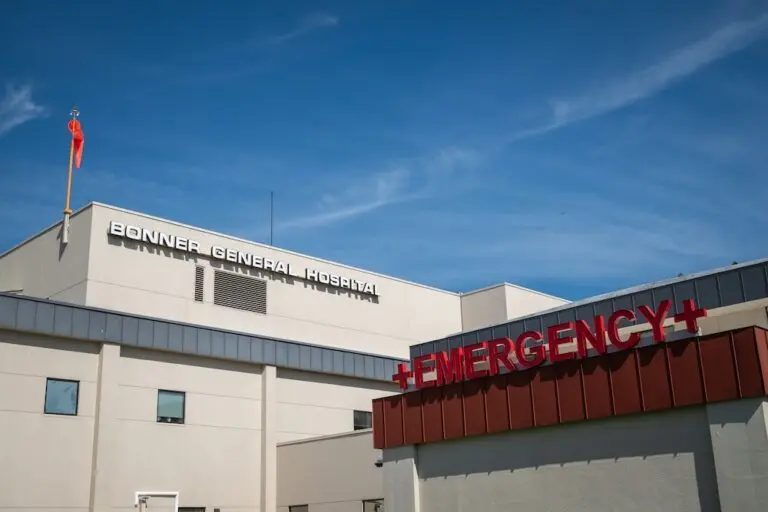
In Sandpoint, Bonner General Health was built in the early 1970s, and that comes with some limitations, Hennessy said. He is hoping that if the hospital’s awarded a rural health grant, the hospital could invest in a new air handler for the operating room to control humidity.
As of now, he said, certain operations, such as total knee replacements, have to be canceled if the humidity is too high.
“Every summer, we’ve had at least a couple weeks where we’ve had to cancel doing any kind of inpatient or those larger cases due to humidity issues,” Hennessy said.
The project would cost around $4.5 million, he said.
He said the hospital’s medical record system needs to be consolidated — there are five currently in use — and upgraded. But a large electronic medical record system can cost more than $1 million a year to run, Hennessy said.
In Benewah County, incidents of heart attacks and strokes are high, according to Benewah Community Hospital CEO Burt Keltner, and he’s hoping to use a grant to purchase equipment to support a new cardiac and dialysis care program.
He said he also wants to look at purchasing an upgraded MRI machine to speed up efficiency of imaging, and using the funds to start up a new nurse recruitment program to “wean off” traveling nurses — who fill vacant positions through temporary contracts at a much higher cost to the hospital.
The Benewah and Bonner hospitals are designated as “critical access,” which means the federal government reimburses costs for Medicare-eligible services. The payments come in a once-a-year lumpsum, Keltner said, which can create challenges around stretching low cash flows through the next year or starting new programs.
He said a grant to start up a nurse recruitment program could go a long way to being sustained through other means.
“If it’s done appropriately, it’s a way for it to feed itself,” he said.
Housing pressures hamper health care worker recruitment
Idahoans have seen increasing housing costs all around the state and because of this, it’s become increasingly difficult for small hospitals to recruit and retain professionals.
“We’re very fortunate to live in a beautiful area with a ski resort and a lake right in our backyard, but the problem is that the cost of living is quite high. And that housing becomes a problem for quite a bit of our staff,” said Hennessy from Bonner General. “So they want to move here, but due to the housing prices, sometimes it’s just not feasible.”
He said the hospital, like many across the nation, is seeing a shortage in workers such as surgical nurses, surgery scrub technicians, physical therapists, and nurses.
“So, the same positions that we’re hearing from other hospitals in our area that are also struggling to recruit those,” he said, “which also makes it tough, because you have one candidate, and you might have four hospitals within the service area that are all competing for that one applicant.”
St. Maries has seen a steep increase in retirees moving in, Keltner said, which has caused an increased population of patients using Medicare and a housing squeeze.
“We need nurses. We need lab workers. We need radiology techs,” Keltner said, “and it’s kind of a double edged sword, where we have a lot of young people that might want to live here, but a lot of times, especially in northern Idaho, they can’t afford to buy something, or there just isn’t anything available for them to even get started into. Rentals are few and far between.”
Zillow data released last summer found Idaho’s housing price growth between 2015 and 2025 topped the nation with a 156% increase, KTVB reported.
Insurance delays, denials and lower reimbursements stretch cash reserves thin
The aging population served by rural areas also means a number of patients are covered by Medicare, which tends to reimburse at a lower rate than private health insurance plans, Keltner said.
Some patients purchase Medicare Advantage plans, an option for Medicare recipients to purchase private insurance that offers the same coverage.
Increasingly, claims filed for Medicare Advantage plans are denied, Keltner and Hennessy said. The practice of requiring prior authorization for coverage of a service or treatment used to be rare and only required for limited services, Keltner said.
“Now it’s getting to where these pre-authorizations are put on everything, every time you turn around, for every procedure you can imagine,” Keltner said. “And so those are slowly building in number, creating difficulty, trying to jump all these hurdles so that we can get paid appropriately.”
A KFF Health analysis of federal data found that Medicare Advantage insurers in 2024 denied 4.1 million prior authorization requests out of about 52.8 million requests, an about 8% denial rate.
Keltner and Hennessy said the number of services that require prior authorization and the rate of denials has continued to increase, even just since the beginning of this year.
Keltner said the process feels automatic, with denials coming in almost the instant a claim is filed.
“I’m completely convinced that, for the last two or three years, large, commercial insurance companies have installed algorithms to auto-deny a lot of things right when they first come in,” he said, “just to create more workflow for the people that are submitting. I have no doubt, because it’s not possible for a person on the other end to actually make a decision.”
In 2023, ProPublica reported on a tool the insurer Cigna used to instantly reject claims without doctors reviewing the file. Over a period of two months the prior year, Cigna doctors denied over 300,000 requests for payments using this method, spending an average of 1.2 seconds on each case, ProPublica reported.
Hennessy said when insurers do come back with lower reimbursements or denials, small hospitals have no leverage to negotiate.
“So usually it’s just insurance is coming each year with a lower number, kind of just expecting us to take it,” Hennessy said.
Medicaid cuts already affecting reimbursement, hospitals bracing for more
Idaho Gov. Brad Little last summer approved 4% Medicaid provider rate cuts, reducing the amount doctors are paid to provide services for Medicaid patients, in response to a projected budget shortfall.
Idaho cuts doctor pay rates for Medicaid. More cuts could come, Health and Welfare says.
Congress in July in the “Big Beautiful” law approved significant reductions in Medicaid spending and changes such as work requirements that are estimated to drop people from coverage. The Idaho Legislature also approved its own work requirements for some Medicaid recipients.
“Bottom line, any percentage cut is going to have a huge effect,” Hennessy said. “Especially to rural hospitals where they don’t have large margins to begin with. So just for example, 4% cuts happen here, that’s several $100,000 directly to our bottom line that we’re no longer being reimbursed.”
He said the hospital will also still have to continue serving those who might get dropped from the program and become uninsured. He said emergency care for those patients will have to be covered by the hospital through its charity care program.
He said about 10% of the patients at Bonner General are covered by Medicaid. Keltner said about 12% of patients at Benewah Community Health are enrolled in Medicaid. Kelner noted that many critical access hospitals operate at about a 1% profit margin, meaning a potential 10% cut to about 10% of the patients would eliminate that entire margin.
“We weren’t built to be a profit center,” Keltner said. “We weren’t built in order to gouge and make just tons and tons of money, but we do need to be financially viable. So we have to balance that viability with as many services as we can offer for the size of community that we serve.”
“That’s the difficulty,” he said. “But we just have to keep in the forefront of our mind, and what keeps us optimistic is that we’re here to serve.”
Idaho Capital Sun is part of States Newsroom, a nonprofit news network supported by grants and a coalition of donors as a 501c(3) public charity. Idaho Capital Sun maintains editorial independence. Contact Editor Christina Lords for questions: info@idahocapitalsun.com.