OLYMPIA, WA – A federal judge is weighing whether to toss redrawn political maps for Washington’s Legislature that he approved two years ago, a move that state officials warn would take “a wrecking ball” to the upcoming primary, possibly forcing it to be rescheduled.
The legal tussle centers on U.S. District Court Judge Robert Lasnik’s controversial penning of new legislative district boundaries to enhance the political voice of Latino voters in the Yakima Valley. This revamp shifted more than 300,000 people across 13 legislative districts in eastern and western Washington ahead of elections in 2024.
Those challenging the maps argued in a motion filed last week that Lasnik should undo his decision because it does not align with the U.S. Supreme Court’s direction in Louisiana v. Callais, a ruling in late April that significantly curtailed the use of race in redrawing legislative boundaries.
They want him to restore the lines drawn by Washington’s bipartisan redistricting commission in 2021. Alternatively, they want Lasnik to inform the U.S. Supreme Court that he’s prepared to do so if a separate appeal on the maps that is pending before the high court is sent back to him.
“The circumstances of this case strongly favor relief,” and to not do so would be a “manifest injustice,” reads the brief filed in U.S. District Court for the Western District of Washington on behalf of Jose Trevino and state Rep. Alex Ybarra, R-Quincy. Lasnick allowed them to intervene in the case at an earlier stage, in 2022. House Minority Leader Drew Stokesbary, R-Auburn, an attorney, is part of the firm representing them.
‘Simply too late’
The plaintiffs — Latino voters whose earlier lawsuit resulted in the map approved by Lasnik — submitted a blistering response in court last week, describing the intervenors’ arguments as flimsy and denouncing their call for judicial haste.
Asking the court to reverse the boundary changes and restart an election cycle already underway “is unjustified and prejudicial,” they said. “Nothing warrants such an imprudent compression of time on a motion of such consequence,” they added.
Stuart Holmes, Washington’s election director, said in a declaration to the court this week that of the 294 people who filed last week to run for a legislative office, 67 are seeking seats in one of the districts with changed boundaries.
The request to restore the previous map is “a recipe for chaos,” Secretary of State Steve Hobbs said in his legal response to the motion.
“It is simply too late to alter legislative districts for the 2026 elections,” he said. Ordering changes now “will create significant voter confusion, and result in significant expenses for Washington and counties in Washington,” he said.
He also said it would “create a significant possibility” of the Aug. 4 primary getting delayed.
Separately, attorneys for the state and for the plaintiffs pointed out that Trevino and Ybarra already petitioned the Supreme Court to consider their challenge to the constitutionality of the maps Lasnik approved. Responses from the state and plaintiffs to that petition are due by June 2.
Since the Supreme Court could soon weigh in, there is no need for Lasnik to act now, attorneys for the state argued.
But Trevino and Ybarra disagree. They contend the status quo “will almost certainly ensure that 2026 legislative elections in Washington are held under a map that can no longer withstand constitutional scrutiny.”
Chalking the lines
The original plaintiffs in the case are Latino voters who contested the 15th Legislative District borders adopted by the state’s redistricting commission and approved by the Washington Legislature in early 2022.
The lawsuit contended that map violated the federal Voting Rights Act because it impaired the ability of Latino voters to participate equally in elections. The case included a trial in June 2022 featuring testimony from commissioners and voting experts.
Plaintiffs argued that while Latinos were a slight majority of the district’s voters, the final contours included areas where their turnout is historically lower and excluded communities where Latinos are more politically active.
This fracturing can depress Latino turnout and weaken their voting strength, they argued.
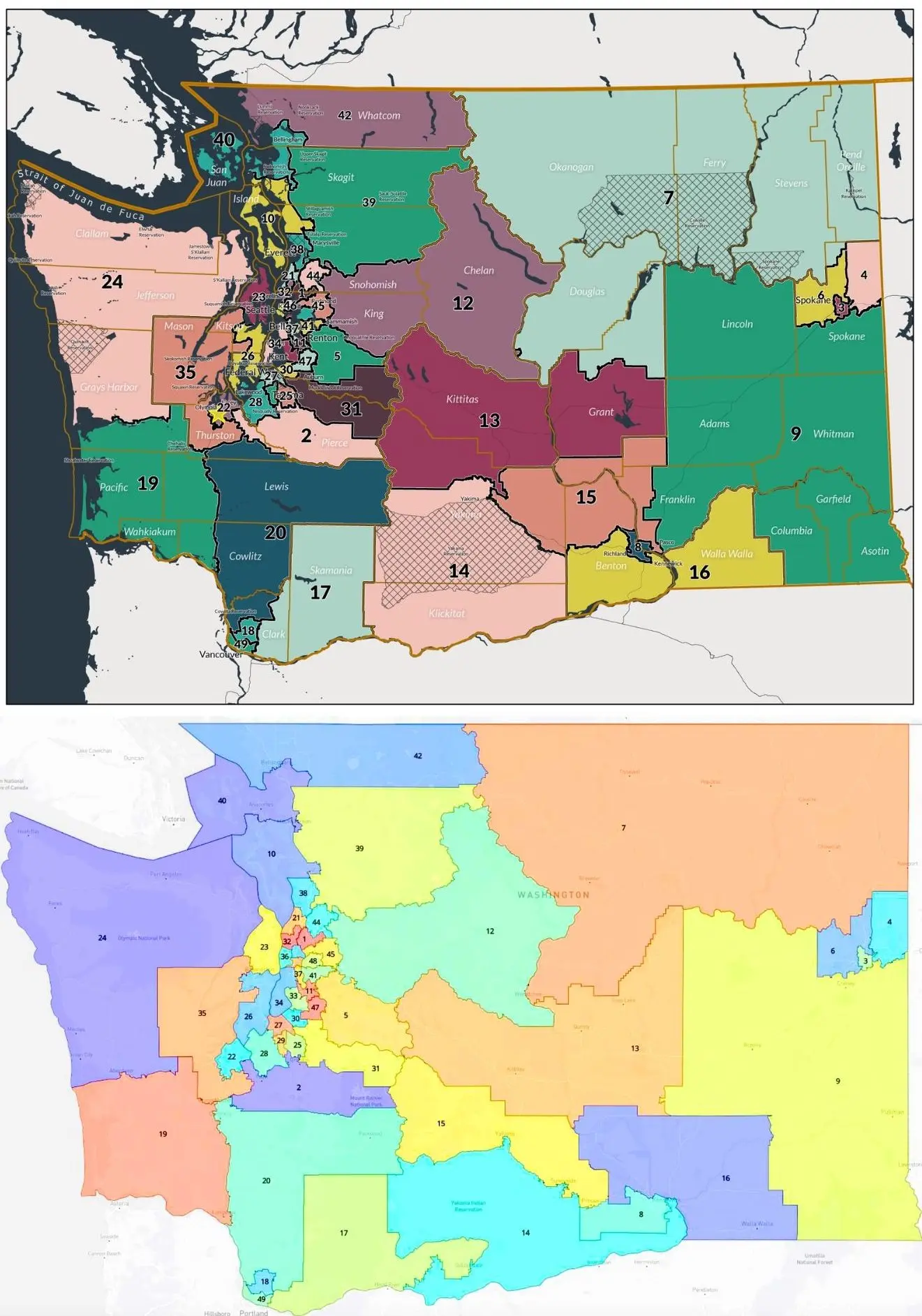
Lasnik agreed, ruling in August 2023 that the configuration of the district diluted the Latino vote. In early 2024, Lasnik approved a new district map covering communities from East Yakima to Pasco and including Wapato, Toppenish, Granger and Sunnyside. Nearly all of the historic lands of the Yakama Nation Reservation are in the district.
As part of the solution, he renumbered the 15th district as the 14th, ensuring legislative positions, including the state Senate seat, were on ballots in presidential election years starting that year.
Changing the lines in the Yakima Valley also had a domino effect, with western Washington districts in King, Pierce, Thurston and Clark counties reconfigured too.
Trevino and Ybarra, and a third man, Ismael Campos, intervened in the case as registered voters. They argued race was given too much weight in the drawing of boundaries and that the map should be redone with a focus on compactness and communities of interest.
Washington State Standard is part of States Newsroom, a nonprofit news network supported by grants and a coalition of donors as a 501c(3) public charity. Washington State Standard maintains editorial independence. Contact Editor Bill Lucia for questions: info@washingtonstatestandard.com.